
Your Read is on the Way
Every Story Matters
Every Story Matters
The Hydropower Boom in Africa: A Green Energy Revolution Africa is tapping into its immense hydropower potential, ushering in an era of renewable energy. With monumental projects like Ethiopia’s Grand Ethiopian Renaissance Dam (GERD) and the Inga Dams in the Democratic Republic of Congo, the continent is gearing up to address its energy demands sustainably while driving economic growth.
Northern Kenya is a region rich in resources, cultural diversity, and strategic trade potential, yet it remains underutilized in the national development agenda.

Can AI Help cure HIV AIDS in 2025

Why Ruiru is Almost Dominating Thika in 2025

Mathare Exposed! Discover Mathare-Nairobi through an immersive ground and aerial Tour- HD

Bullet Bras Evolution || Where did Bullet Bras go to?
In South Korea, a child’s first birthday is more than a personal milestone—it’s a culturally significant event known as Doljanchi (돌잔치). Rooted in history, tradition, and family values, this celebration is both festive and symbolic, representing the child's survival through the critical first year of life. What might seem like a simple birthday party is, in fact, a deeply meaningful rite of passage observed with elaborate customs, traditional attire, and rituals that date back centuries.
In past centuries, infant mortality rates in Korea were high due to poor sanitation, lack of medicine, and harsh living conditions. As such, a child’s survival of the first year was seen as a major triumph. Families began celebrating the first birthday as a way of expressing gratitude, hope, and community support for the child’s continued health.
Over time, the Doljanchi became a cultural norm, evolving into a blend of ancestral tradition and contemporary festivity.
The heart of the Doljanchi lies in a ceremonial table setting called the “doljabi” table, which is adorned with food, decorations, and symbolic objects. The child is placed in front of this table wearing a traditional hanbok—often a brightly colored silk garment paired with a jobawi (a winter cap) or a bokgeon (a headgear for boys).
One of the most anticipated parts of the celebration is the Doljabi ritual, where the child is encouraged to pick one or more items from a set of symbolic objects. Each item is believed to predict the child’s future path:
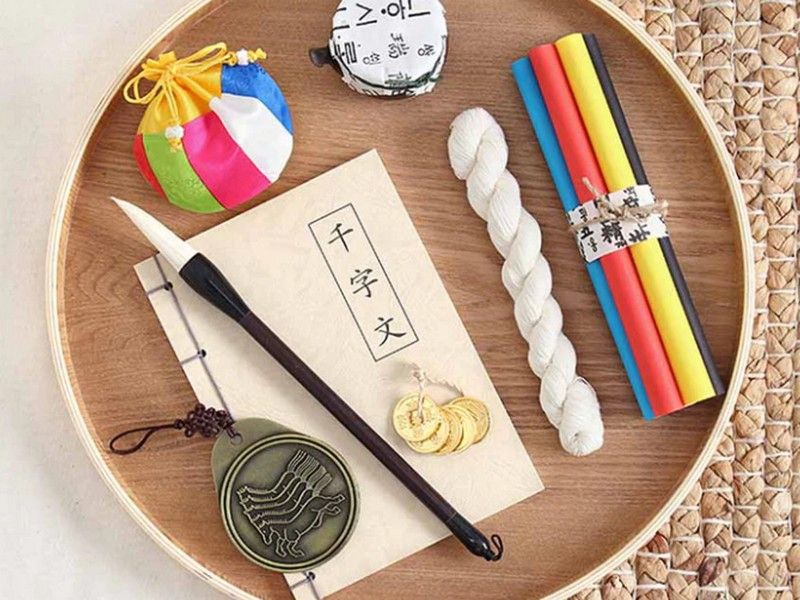
-Thread – Long life
-Rice or rice cake – Prosperity and good health
-Pencil or book – Academic success or wisdom
-Money – Wealth
-Stethoscope or gavel (modern additions) – Medical or legal career
While this is seen mostly as a fun tradition today, many families still cherish the moment as a sentimental highlight of the ceremony.
No Doljanchi is complete without an impressive spread of traditional Korean foods. A large doljanchi table, or dolsang, is beautifully arranged with tteok (rice cakes), fruits, sweets, and other symbolic delicacies. The rice cakes, especially baekseolgi (steamed white rice cake), symbolize purity and a fresh start.
Decorations typically include calligraphy banners, photos of the baby, and colorful balloons or traditional patterns. Modern families may also hire photographers and event planners to capture and enhance the atmosphere.
Doljanchi is often attended by extended family, friends, and sometimes even community members. Guests bring gifts for the baby and the parents, and enjoy a meal together after the ceremonial portion. It serves not only as a birthday party, but also as an occasion to honor family bonds, ancestors, and collective blessings.
In today’s Korea, many Doljanchi celebrations are held in banquet halls or restaurants, with professional event services, customized hanboks, and even digital invitations. Despite modernization, the emotional and cultural importance of the event remains intact.
While the core elements of Doljanchi are preserved, modern families frequently incorporate new themes, Western-style cakes, and contemporary entertainment. Some parents even livestream the event for family members abroad, blending tradition with technology.
In urban settings, Doljanchi celebrations may be more stylish and lavish, but in rural or more traditional households, they remain deeply rooted in ancestral values.
Read this related artile: What Is a Bar or Bat Mitzvah in Judaism?
Doljanchi is more than a first birthday—it’s a celebration of life, resilience, family, and hope. In South Korea, this event bridges the past and the present, bringing generations together through a cherished ritual. Whether held modestly at home or elaborately in a banquet hall, the Doljanchi reflects the universal joy of watching a child grow, and the uniquely Korean way of honoring that journey.






0 comments