
Your Read is on the Way
Every Story Matters
Every Story Matters
The Hydropower Boom in Africa: A Green Energy Revolution Africa is tapping into its immense hydropower potential, ushering in an era of renewable energy. With monumental projects like Ethiopia’s Grand Ethiopian Renaissance Dam (GERD) and the Inga Dams in the Democratic Republic of Congo, the continent is gearing up to address its energy demands sustainably while driving economic growth.
Northern Kenya is a region rich in resources, cultural diversity, and strategic trade potential, yet it remains underutilized in the national development agenda.

Can AI Help cure HIV AIDS in 2025

Why Ruiru is Almost Dominating Thika in 2025

Mathare Exposed! Discover Mathare-Nairobi through an immersive ground and aerial Tour- HD

Bullet Bras Evolution || Where did Bullet Bras go to?
New South Wales is reeling from a catastrophic flood event that has plunged large portions of the state into chaos, misery, and uncertainty. Driven by an unrelenting, slow-moving low-pressure system, the deluge has delivered rainfall levels unlike anything seen in living memory for many residents. The storm has since been declared a natural disaster, but for those caught in the flood zone, that declaration offers little comfort as floodwaters continue to rise and the threat of further devastation looms large.
Over 50,000 people are currently living under evacuation warnings, urged to leave their homes as emergency responders race against time and nature to save lives. Helicopters, boats, and high-clearance rescue vehicles have become lifelines in areas where entire communities have been cut off from the rest of the world. Roads are underwater, communication is limited, and infrastructure is crumbling. The emotional and physical toll is mounting by the hour.
The floods have already turned deadly, with two fatalities confirmed and at least two more individuals still missing in the chaos. A 63-year-old man’s body was found on a flooded property in Moto, near the devastated town of Taree. Authorities have launched an investigation, but initial reports suggest he was swept away by the rapidly rising waters.
In a separate incident, a man in his 30s was discovered dead in a submerged vehicle near Rosewood on the Mid North Coast, just hours after desperate calls for help had been received from someone trapped in the same area. Meanwhile, the search continues for a woman whose car was caught in floodwaters, and another man who vanished while walking near an inundated roadway. With each hour that passes, hope dims.
Behind each fatality and missing person is a family waiting in agony, a neighborhood forever changed, and emergency crews pushing through exhaustion in hopes of preventing the next name from being added to the list.
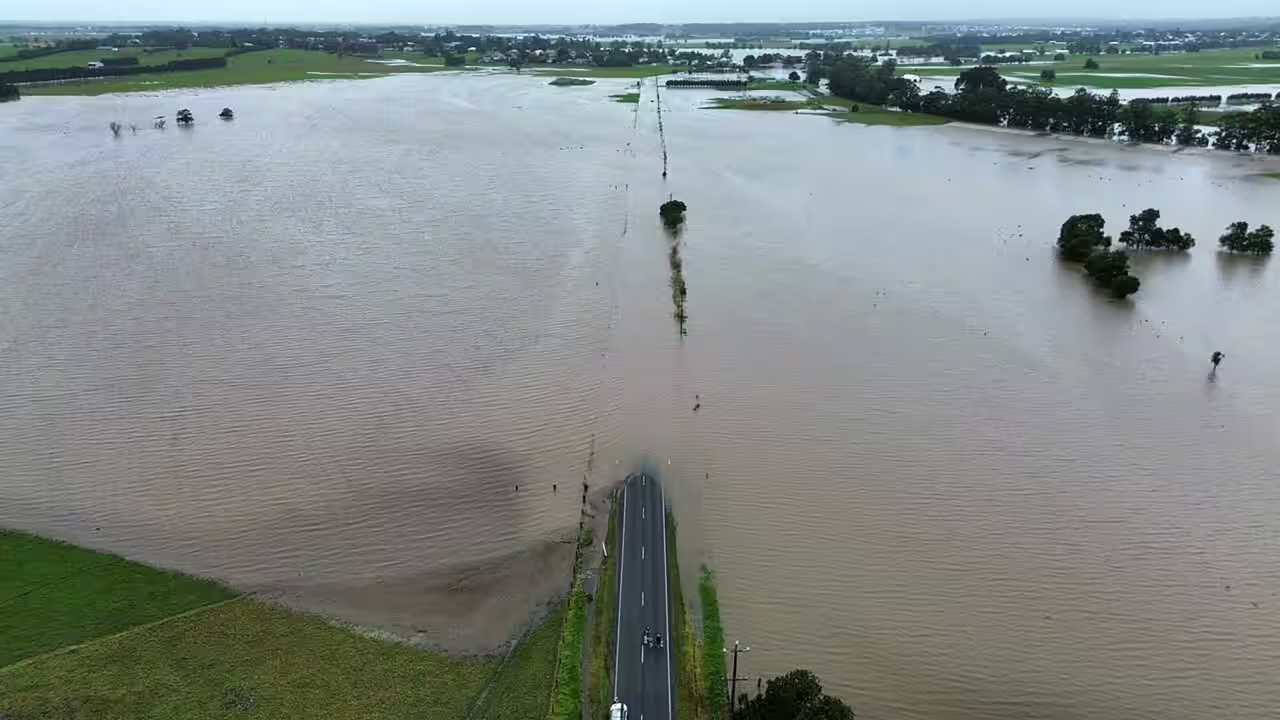
As the floodwaters advance, daily life in New South Wales has come to a screeching halt. More than 100 schools have shut their doors, leaving thousands of children without access to education. Families are scrambling to find shelter and basic necessities as electricity outages continue to affect tens of thousands of homes and businesses.
Entire suburbs are now islands, accessible only by air or boat. Emergency evacuation centres have been activated across the region, offering temporary refuge to families forced to abandon their homes. But not everyone is able to flee. Some residents, especially the elderly, those with disabilities, or those with small children, remain trapped—waiting for help to arrive, or for the floodwaters to recede.
The scenes unfolding in towns like Taree are haunting. Once-bustling communities are now silent, with water lapping at rooftops and vehicles submerged beneath a churning brown tide. In Taree, river levels reached 6.3 meters—smashing records that had stood for nearly 100 years and turning streets into rivers and parks into lakes.
Premier Chris Minns has made urgent public appeals, warning that the state is “far from out of the woods.” He emphasized the unpredictability of the storm and the seriousness of the threat, stating that those in designated “prepare to evacuate” zones should not wait until it’s too late.
He acknowledged that for some, evacuation is simply not possible due to personal or medical circumstances. “But if the majority can get out safely, it makes our job of rescuing those who can’t far easier,” Minns stated in a press briefing. His words are not just cautionary—they are a plea grounded in the brutal reality of stretched emergency services and worsening weather conditions.
The weather system is expected to deliver another 300mm of rainfall over the next 48 hours, a terrifying prospect for communities already underwater. In many areas, emergency services are warning that rescue resources may not be able to reach everyone in time if conditions continue to deteriorate.
More than 2,000 emergency service workers have been deployed across the state, and they’ve already carried out more than 800 flood rescues since the disaster began. In the last 24 hours alone, over 300 rescues were conducted—many of them involving individuals stranded on rooftops, clinging to hope as floodwaters surged below them.
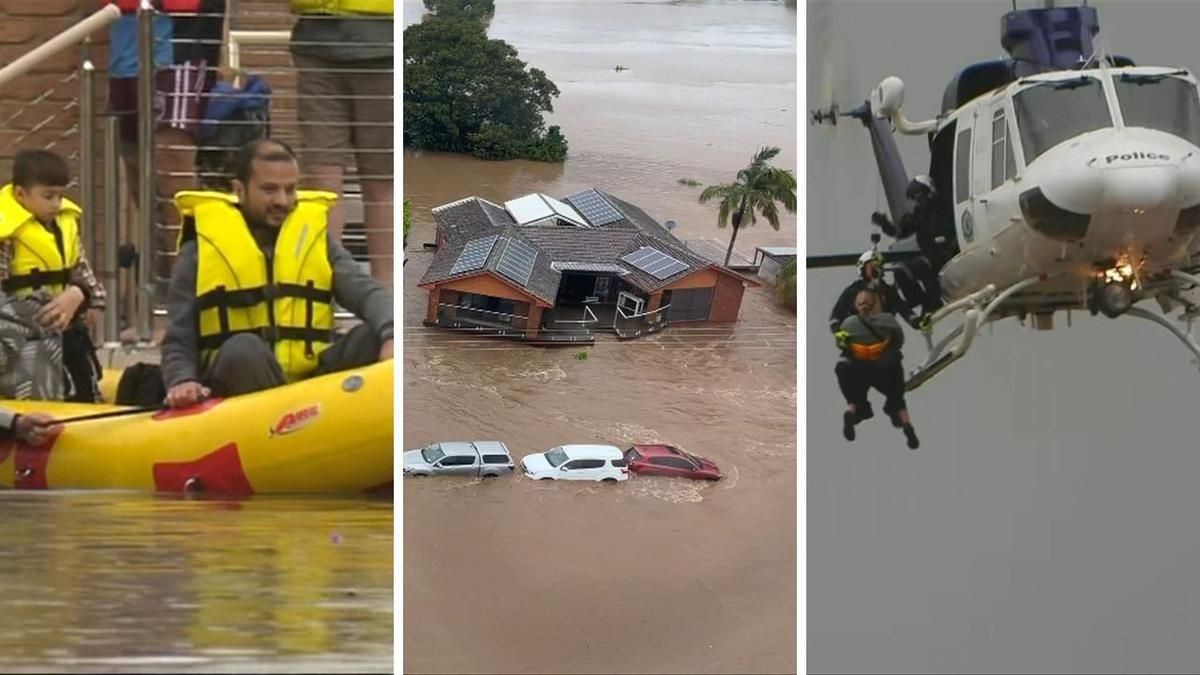
Helicopters winched 22 people to safety, including families trapped in their homes and four people marooned on a submerged bridge. In one touching moment, four dogs and a cat were rescued alongside their human companions—small reminders that in disaster, compassion still prevails.
NSW State Emergency Service Assistant Commissioner Colin Malone described the operation as both relentless and dangerous. Fast-moving rivers and flooded roads have made many areas nearly impossible to access. Despite the danger, rescue teams continue to deploy air and water units to isolated towns, often working through the night in driving rain.
Emergency Services Minister Jihad Dib said the government is throwing “everything we’ve got” at the crisis. But even with full force applied, the scope of the disaster remains overwhelming. “We’ve broken records no one wants to break,” he said grimly, referring to rainfall and flood levels not seen in generations.
As the storm continues to batter the state, the forecast paints a bleak picture. With an additional 300mm of rain expected by Friday, rivers are expected to swell further, and flash floods remain a serious threat. Nearly 10,000 homes are in imminent danger of being inundated on the Mid North Coast alone.
Premier Minns confirmed that federal support has been offered and is being mobilized, but even with additional resources, the road ahead will be long and arduous. Food supplies are dwindling in cut-off communities, medical assistance is strained, and anxiety levels are rising as people come to grips with the scale of what they’ve lost.
This disaster will not be resolved in days. The clean-up, the recovery, and the healing—both physical and emotional—will take months, if not longer. For now, the focus remains on survival. Getting through today. Making it to tomorrow.






0 comments