
Your Read is on the Way
Every Story Matters
Every Story Matters
The Hydropower Boom in Africa: A Green Energy Revolution Africa is tapping into its immense hydropower potential, ushering in an era of renewable energy. With monumental projects like Ethiopia’s Grand Ethiopian Renaissance Dam (GERD) and the Inga Dams in the Democratic Republic of Congo, the continent is gearing up to address its energy demands sustainably while driving economic growth.
Northern Kenya is a region rich in resources, cultural diversity, and strategic trade potential, yet it remains underutilized in the national development agenda.

Can AI Help cure HIV AIDS in 2025

Why Ruiru is Almost Dominating Thika in 2025

Mathare Exposed! Discover Mathare-Nairobi through an immersive ground and aerial Tour- HD

Bullet Bras Evolution || Where did Bullet Bras go to?
The 2025 London Marathon wasn’t just a race; it was a statement. It marked the day when seasoned giants slipped and a fearless new generation seized the spotlight. Under a blazing spring sun, Kenya’s Sebastian Sawe delivered a tactical masterclass, leaving a cluster of world champions gasping in his wake. Meanwhile, Ethiopia’s Tigst Assefa shattered expectations and records alike, signaling that the marathon world is no longer a playground for the old guard.
From the first few miles, the men's lead group was a constellation of greatness: Eliud Kipchoge, Tamirat Tola, Jacob Kiplimo, and other marathon royalty. But the early pacing told another story—a group running cautious, almost fearful of burning out too soon. They crossed the halfway point in a modest 1:01:30, a pace practically begging for disruption.
Enter Sebastian Sawe. Timing his move with surgical precision just after a drinks station, Sawe made a gutsy decision that would define the race—he skipped hydration entirely and launched a stunning breakaway. It wasn’t a desperate sprint; it was cold, ruthless strategy. By the time Kiplimo realized what was happening, Sawe had already built a commanding lead.
Even as Kiplimo fought valiantly to recover, the die was cast. Sawe, looking effortless against the iconic backdrop of Buckingham Palace, claimed the crown with a time of 2:02:27. The defending champion Alexander Mutiso Munyao managed to sneak into third after a thrilling sprint finish, but the real headline was the subtle dethroning of marathon legends. Kipchoge, once the unshakable emperor of long-distance running, faded to a distant sixth, marking what might quietly be the end of an era.
On the women’s side, the drama was no less intense—but it unfolded with a different flavor. Tigst Assefa arrived in London with unfinished business after falling short last year. This time, she wasn’t about to let history repeat itself.
From the start, Assefa, along with Kenya’s Joyciline Jepkosgei and Olympic gold medalist Sifan Hassan, set a blistering tempo. Early splits hinted at an audacious 2:12 finish—territory that would tear down previously untouchable records. As they surged past Tower Bridge, Hassan's struggles became visible. The Dutch champion, carrying the physical toll of a post-Olympics layoff, couldn't maintain the ferocious pace.
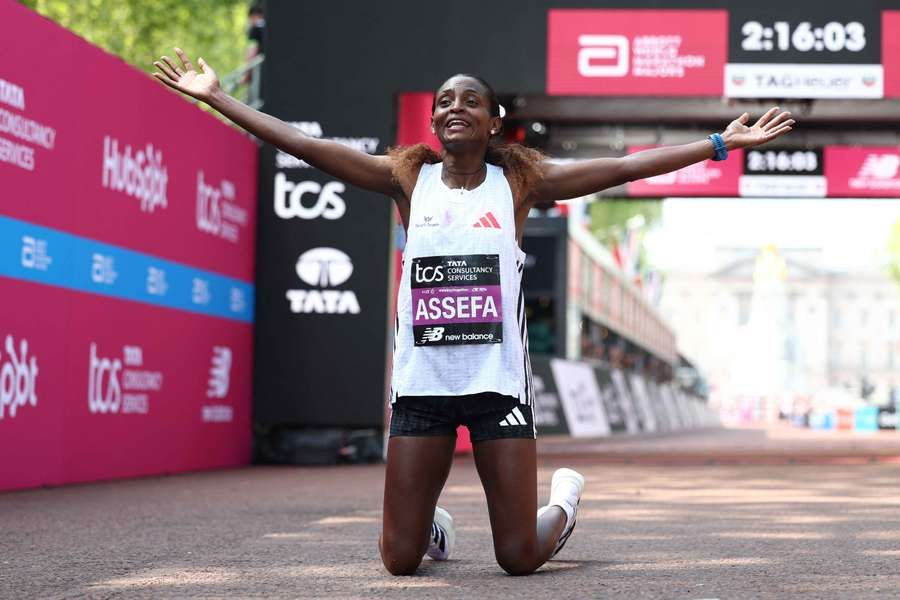
While Hassan tried to cling onto the leaders with sheer will, Assefa had other ideas. She shifted gears just after the two-hour mark, breaking free from Jepkosgei with a drive that turned the streets of London into her personal runway. When Assefa crossed the line in 2:15:50, it wasn’t just a win—it was an emphatic declaration of supremacy. Jepkosgei, exhausted but brave, clung onto second, while Hassan—worn yet defiant—settled for third.
Unlike marathons where brute endurance often decides the winner, this year’s London Marathon rewarded boldness and brains. Sawe’s well-timed breakaway and Assefa’s late surge weren’t just physical feats; they were mental masterstrokes. Meanwhile, small decisions—like grabbing a drink or missing a surge—separated champions from also-rans.
Kipchoge’s quiet implosion, Kiplimo’s late realization, Hassan’s fading engine—these weren’t just isolated misfortunes. They were the inevitable consequences of a sport moving to a faster, less predictable rhythm, driven by a younger, hungrier generation.
The 2025 London Marathon wasn't about nostalgia—it was about audacity. The course that once celebrated the steady, rhythmic dominance of legends now echoed with the unpredictable, electrifying energy of new blood. With Sawe and Assefa at the forefront, the future of marathon running promises to be faster, riskier, and a lot more thrilling.
And if this weekend proved anything, it’s that the age of predictability in long-distance running is officially over. The kings and queens of yesterday must now reckon with a breed that runs not just to win, but to rewrite the rules.






0 comments