
Your Read is on the Way
Every Story Matters
Every Story Matters
The Hydropower Boom in Africa: A Green Energy Revolution Africa is tapping into its immense hydropower potential, ushering in an era of renewable energy. With monumental projects like Ethiopia’s Grand Ethiopian Renaissance Dam (GERD) and the Inga Dams in the Democratic Republic of Congo, the continent is gearing up to address its energy demands sustainably while driving economic growth.
Northern Kenya is a region rich in resources, cultural diversity, and strategic trade potential, yet it remains underutilized in the national development agenda.

Can AI Help cure HIV AIDS in 2025

Why Ruiru is Almost Dominating Thika in 2025

Mathare Exposed! Discover Mathare-Nairobi through an immersive ground and aerial Tour- HD

Bullet Bras Evolution || Where did Bullet Bras go to?
President Samia Suluhu Hassan's journey into leadership began with humble yet determined academic beginnings in the semi-autonomous islands of Zanzibar. Born in 1960, she pursued her secondary education in the late 1970s, completing it in 1977. At a time when educational opportunities for women were limited, particularly in East Africa, her perseverance to complete her schooling stood out as a marker of ambition.
Soon after, she joined the Ministry of Planning and Development as a clerk—a position that exposed her to the workings of government bureaucracy and gave her firsthand experience in the administrative machinery of the state.
Though her role was initially clerical, she seized opportunities to enhance her skills through short professional courses and hands-on training. This period marked the early awakening of her interest in governance, policy, and development—a foundation that would later define her political identity.
Recognizing the need for formal training to rise through the ranks of public service, Samia enrolled in an Advanced Diploma in Public Administration in 1986. She undertook this program at what was then known as the Institute of Development Management, now Mzumbe University. The diploma equipped her with structured knowledge in areas such as public sector ethics, administrative law, strategic planning, and civil service management.
It was during this phase that she developed a disciplined approach to leadership—rooted in systems thinking and accountability. Her educational experience here also strengthened her belief in institutions and their role in shaping service delivery, justice, and development. This qualification marked her transition from a civil servant to an emerging leader with the capacity to engage more substantively with policymaking and institutional governance.
In the early 1990s, Samia sought to broaden her perspective beyond the borders of Tanzania by undertaking postgraduate studies in the United Kingdom. Between 1992 and 1994, she pursued and earned a Postgraduate Diploma in Economics from the University of Manchester. This academic pursuit marked a critical shift in her intellectual development—from administrative management to economic policy formulation.
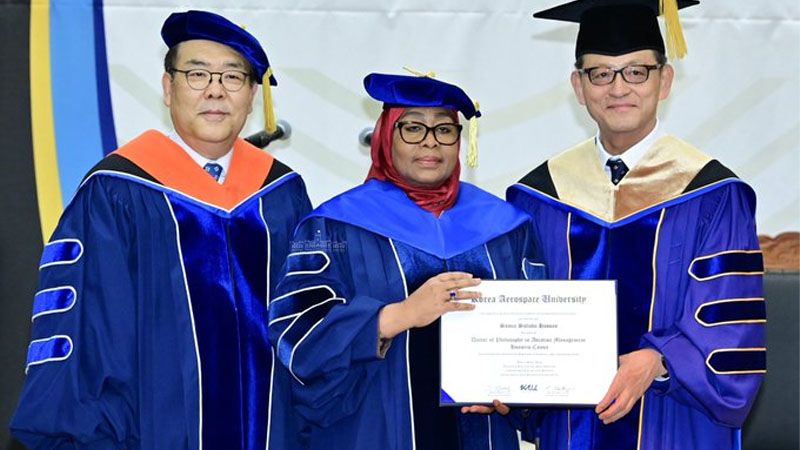
Her exposure to global economic systems, financial modeling, and development strategies enhanced her ability to analyze macroeconomic trends and their implications on domestic policies. With this training, she became increasingly aware of how economic structures can be used to drive national transformation.
It also prepared her for future responsibilities involving budget oversight, national planning, and foreign investment engagement. Her education in economics later became instrumental when she was assigned leadership roles in ministries and as Vice President, eventually shaping her economic vision as head of state.
Never one to stop learning, Samia deepened her commitment to inclusive development by pursuing a Master of Science in Community Economic Development—a degree jointly delivered by the Open University of Tanzania and Southern New Hampshire University. She completed this program in 2015 while serving in national leadership, exemplifying a lifelong dedication to academic growth alongside public service.
The program emphasized participatory development, small enterprise support, poverty alleviation, and grassroots economic empowerment. This academic experience resonated deeply with her core political values: placing people at the center of development and ensuring that policy outcomes reach even the most remote corners of society.
The master's degree shaped her focus on social equity, sustainable livelihoods, and economic justice. It also reinforced her belief that national transformation cannot be achieved solely through top-down policies but must be rooted in empowering local communities to define and drive their own development agendas.
President Samia’s academic and leadership credentials have also earned her recognition on the global stage. In 2023, her diplomatic finesse and economic leadership were honored with an honorary doctorate from Jawaharlal Nehru University. The distinction was not merely symbolic—it acknowledged her commitment to multilateralism, economic cooperation, and strengthening South-South relations.
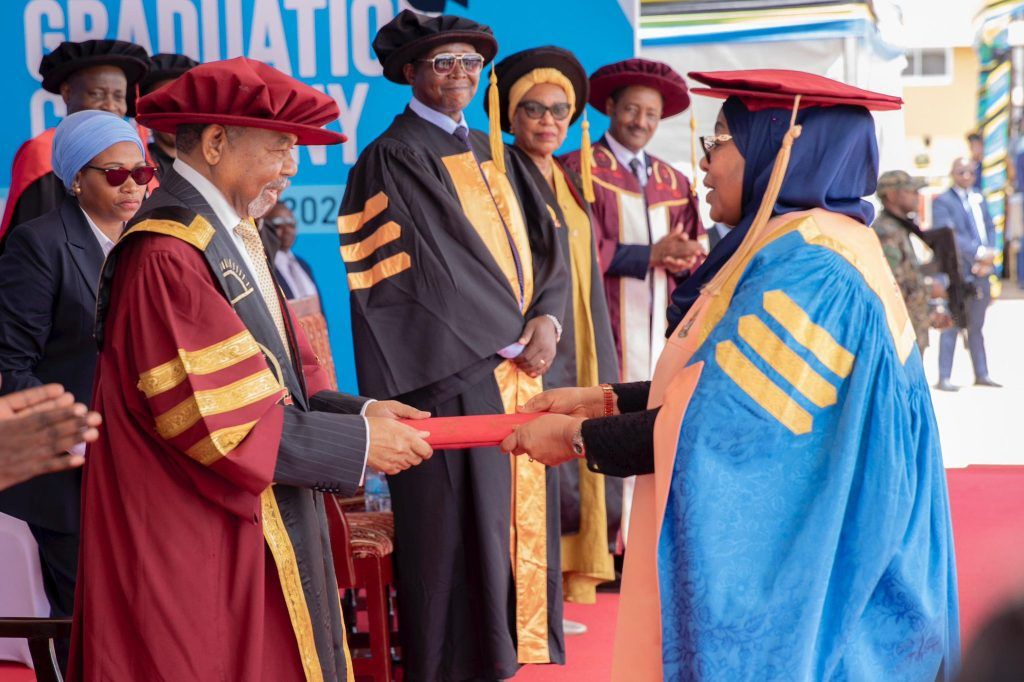
While honorary degrees are often ceremonial, this award served as global affirmation of her strategic role in elevating Tanzania’s voice in regional and international platforms.
These recognitions reflect not only her leadership capabilities but also the intellectual weight she brings to global policy discourse. In a world where leaders are increasingly judged by their analytical clarity and global relevance, her educational credentials continue to elevate Tanzania’s reputation in foreign diplomacy and continental leadership.
President Samia Suluhu Hassan’s academic journey is not a series of disconnected qualifications—it is a deliberate and structured path that has profoundly shaped her philosophy of governance. From her roots in Zanzibar's public sector to her global academic engagements, each phase of her education reflects a deepening commitment to inclusive leadership and development-centered governance.
Her studies in public administration provided her with foundational skills in systems management; her training in economics equipped her to understand complex policy dynamics; and her master’s in community development reinforced her belief in people-driven progress. Collectively, these academic milestones have shaped her presidency—marked by calm diplomacy, strategic investment policies, gender equity initiatives, and a people-first approach to governance.
As Tanzania moves through a new chapter under her leadership, her academic background remains a silent yet steady compass guiding her vision for transformation.






0 comments