
Your Read is on the Way
Every Story Matters
Every Story Matters
The Hydropower Boom in Africa: A Green Energy Revolution Africa is tapping into its immense hydropower potential, ushering in an era of renewable energy. With monumental projects like Ethiopia’s Grand Ethiopian Renaissance Dam (GERD) and the Inga Dams in the Democratic Republic of Congo, the continent is gearing up to address its energy demands sustainably while driving economic growth.
Northern Kenya is a region rich in resources, cultural diversity, and strategic trade potential, yet it remains underutilized in the national development agenda.

Can AI Help cure HIV AIDS in 2025

Why Ruiru is Almost Dominating Thika in 2025

Mathare Exposed! Discover Mathare-Nairobi through an immersive ground and aerial Tour- HD

Bullet Bras Evolution || Where did Bullet Bras go to?
The town of Migori had been buzzing for days. Banners were strung, market stalls cleared, and buses rerouted to accommodate the arrival of President William Ruto. For many, this was a big moment—a chance for the head of state to step into a region long known for its loyalty to opposition politics and extend an olive branch. His speech was expected to address local economic hardship, youth unemployment, and infrastructure development. But the President’s outreach efforts quickly derailed into spectacle, and it wasn't his words that dominated headlines—it was a single flying shoe, and the mayhem it left in its wake.
As President Ruto addressed the crowd from the podium, tensions simmered just beneath the surface. Then came the shoe—hurled from somewhere deep in the crowd. It missed him entirely, landing harmlessly several feet away. But to the President's security team, it might as well have been a grenade. What followed was an eruption of fear disguised as professionalism. Bodyguards closed in on Ruto, forming a human shield. Dozens of plainclothes officers dove into the crowd, grabbing spectators seemingly at random. Sirens wailed as backup forces rushed the venue. Panic spread not because of the shoe—but because of how violently the state responded to it.
In the moments after the shoe-throwing, the rally ground transformed into a war zone. Mothers clutching children were shoved aside. Journalists found their cameras knocked from their hands. Young men—many of whom had come simply to listen—were tackled to the ground and dragged off to police trucks. It was a display of brute force and confusion, with no clear protocol in sight. People ran in every direction, unsure if they were being protected or targeted. The President, shielded and hurried away, never addressed the crowd again. His message about rebuilding trust with the region was left unfinished, eclipsed by flashing batons and terrified screams.
For Migori, the rally was supposed to be a gesture of inclusion, a rare acknowledgement by the presidency of their place in the national conversation. But the fallout from the incident reopened old wounds. The region, already wary of the government, now had fresh grievances. Community leaders expressed outrage not just at the act of the protestor, but at the state’s disproportionate response. Many believed that the shoe—however disrespectful—was a symbolic act, not a dangerous one. The violent aftermath, they argued, was proof that the state still doesn’t understand or respect the rhythms of democratic dissent, especially in counties that have historically stood outside the ruling party’s fold.
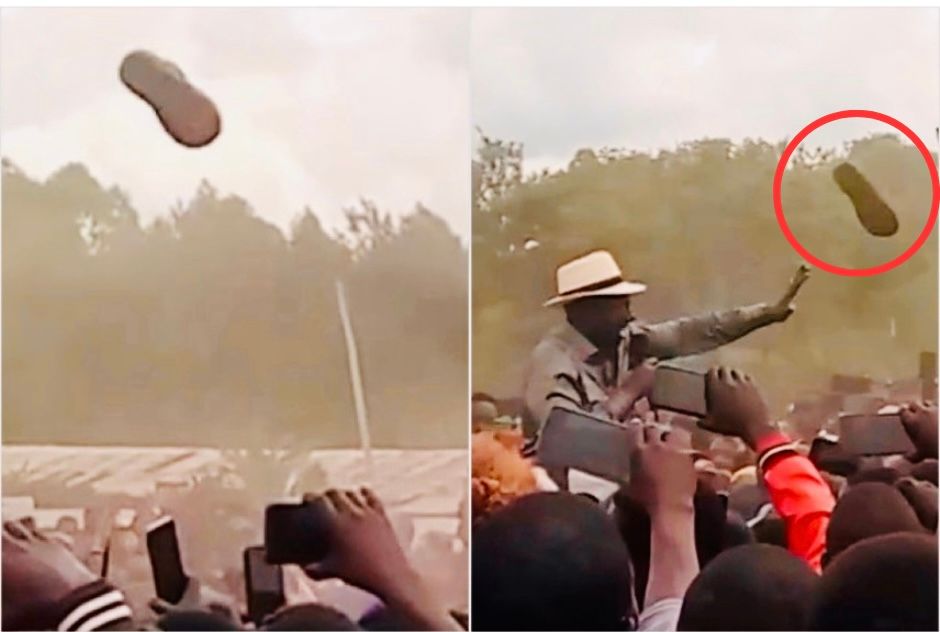
What was intended as an image of unity quickly unraveled into a public relations disaster. National media outlets looped clips of chaos rather than coverage of policy. Analysts debated not the merits of Ruto’s speech, but the failure of his security team to handle a spontaneous act of protest with calm and discipline. Opposition politicians seized the moment to argue that this is precisely why many Kenyans fear centralized power. If a single shoe can unravel such a tightly choreographed event, what does that say about the government's readiness to lead in more complex crises?
In the days following the incident, the government tried to pivot. Officials downplayed the chaos and highlighted economic initiatives announced at the rally. But the damage was done. Migori residents spoke of fear, of feeling criminalized for simply showing up. Civil rights organizations called for an investigation into how law enforcement handled the situation, with some suggesting the response bordered on state intimidation. The incident has become a symbol not of instability in Migori—but of fragility in the very institutions meant to maintain order.
In the end, it wasn't the shoe that hurt President Ruto. It was the system around him that failed. A democratic nation must be able to withstand symbolic defiance without collapsing into repression. Migori’s rally will be remembered not for what the President promised, but for what the public saw: a leadership team that panicked, a security apparatus that cracked, and a people reminded that their voices remain unwelcome when they challenge power—even with nothing more than an airborne shoe.
The episode stands as a cautionary tale. In politics, how you respond often matters more than the provocation itself. And in this case, the reaction told Kenya everything it needed to know.






0 comments