
Your Read is on the Way
Every Story Matters
Every Story Matters
The Hydropower Boom in Africa: A Green Energy Revolution Africa is tapping into its immense hydropower potential, ushering in an era of renewable energy. With monumental projects like Ethiopia’s Grand Ethiopian Renaissance Dam (GERD) and the Inga Dams in the Democratic Republic of Congo, the continent is gearing up to address its energy demands sustainably while driving economic growth.
Northern Kenya is a region rich in resources, cultural diversity, and strategic trade potential, yet it remains underutilized in the national development agenda.

Can AI Help cure HIV AIDS in 2025

Why Ruiru is Almost Dominating Thika in 2025

Mathare Exposed! Discover Mathare-Nairobi through an immersive ground and aerial Tour- HD

Bullet Bras Evolution || Where did Bullet Bras go to?
A Shocking Discovery at the Hospital
Medical personnel on duty at the hospital where Albert Ojwang was brought in have painted a disturbing picture of the teacher’s final moments. According to their detailed accounts, Ojwang arrived at the facility with severe and unmistakable signs of trauma.
Blood streamed from the back of his head, his mouth, and even his eyes — a chilling indication of the intensity of the violence inflicted upon him. The back of his skull bore a gaping wound in the parieto-occipital region, a wound too distinct and deep to be explained by anything but a violent assault.
Swelling on his face, along with heavy bruising on his limbs and torso, suggested he had endured a systematic beating. Nurses quickly concluded there was no opportunity for life-saving intervention — Ojwang was already beyond help by the time he arrived. More disturbingly, they noted his body had already begun to show signs of decomposition, a physiological marker inconsistent with the claim that he had died just moments prior to being brought in.
Adding further suspicion to the unfolding story is the clear discrepancy in the timelines offered by police and hospital officials. Police reports claimed that Ojwang was taken to the hospital at exactly 1:39 a.m. following a medical emergency. However, the hospital’s official log contradicts that account, recording the body’s arrival at precisely 2:00 a.m.
Even more telling is the documented origin of the body — not a rescue vehicle or a family effort, but a transfer from the Central Police Station itself. This fact alone puts a heavy spotlight on the facility where Ojwang had been held and casts significant doubt on the narrative that he collapsed and died.
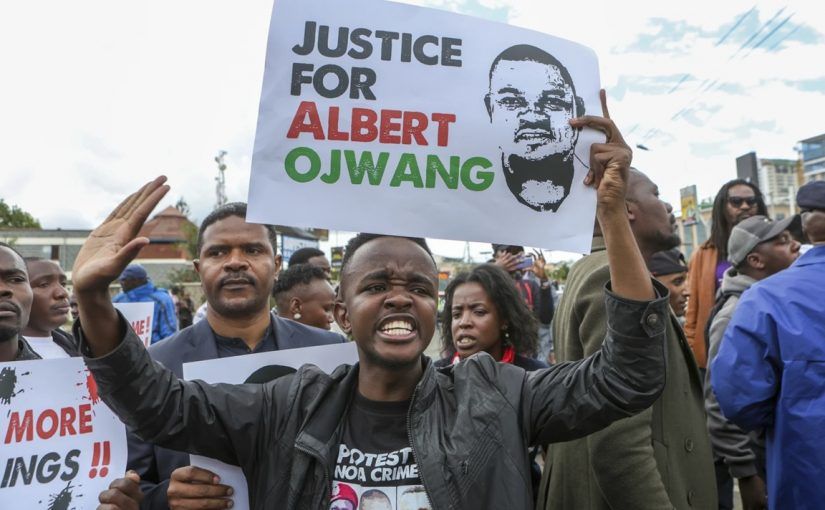
The grim details from the hospital have only intensified public anger, fueling protests that swept through Nairobi and other towns. Businesses shuttered, traffic halted, and crowds of young Kenyans surged into the streets demanding transparency and accountability. Their message was clear: this was not a routine death — it was a tragedy rooted in unchecked abuse and power.
The public’s fury has been ignited not just by the physical evidence of brutality, but by the state’s failure to present a credible account. Ojwang’s case now joins a long and troubling list of unresolved custodial deaths in Kenya, and the calls for systemic reform grow louder with each revelation.
The discrepancies between medical findings and the police narrative have drawn fierce criticism from civil society and legal experts. The parieto-occipital injury in particular — a region at the back of the skull — is commonly associated with blunt force trauma. Combined with facial swelling, bodily bruises, and bleeding from multiple orifices, the physical evidence contradicts claims of natural causes or minor injury.
With mounting pressure from the public, independent pathologists, and human rights groups, a full forensic investigation into Ojwang’s death is now inevitable. The credibility of law enforcement is on trial, and this case has become a litmus test for the government’s commitment to truth, justice, and reform.
Ojwang was not a nameless victim — he was a father, a teacher, a media associate, and a voice of criticism in a digital age. His life was cut short under suspicious circumstances, and the nation’s conscience now demands answers. The sorrow of his family and the fury of the protestors reflect a common cause: the need to confront a culture of impunity that has taken root within parts of Kenya’s police system.
As investigations continue, one thing remains certain — the death of Albert Ojwang will not be forgotten, and it has become a symbol of the urgent need for institutional accountability in Kenya.






0 comments