
Your Read is on the Way
Every Story Matters
Every Story Matters
The Hydropower Boom in Africa: A Green Energy Revolution Africa is tapping into its immense hydropower potential, ushering in an era of renewable energy. With monumental projects like Ethiopia’s Grand Ethiopian Renaissance Dam (GERD) and the Inga Dams in the Democratic Republic of Congo, the continent is gearing up to address its energy demands sustainably while driving economic growth.
Northern Kenya is a region rich in resources, cultural diversity, and strategic trade potential, yet it remains underutilized in the national development agenda.

Can AI Help cure HIV AIDS in 2025
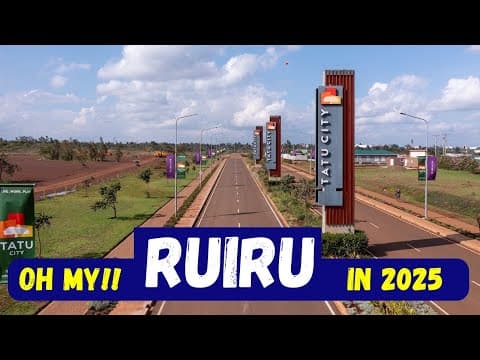
Why Ruiru is Almost Dominating Thika in 2025

Mathare Exposed! Discover Mathare-Nairobi through an immersive ground and aerial Tour- HD

Bullet Bras Evolution || Where did Bullet Bras go to?
The expansion of Kiambu Road from a modest two-lane carriageway into a four-lane dual highway has officially begun—and it's backed by deep Chinese pockets. The Kenya National Highways Authority (KeNHA) confirmed a KSh 38.7 billion loan from China’s EXIM Bank, earmarked for transforming one of Nairobi’s most congested roads into a major transport artery.
The route cuts through Pangani Estate, Muthaiga, and ends in Ndumberi, Kiambu County, covering a vital stretch that links uptown Nairobi to its booming suburban spine. The vision: wider roads, faster traffic, and stronger economic ties between counties.
But this vision comes at a high cost—both financially and environmentally.
KeNHA’s announcement detailed a full transformation under FIDIC Silver Book arrangements, which means the contractor bears full responsibility for design and construction. The overhaul includes:
-Four traffic lanes (dual carriageway)
-Two-lane service roads on each side
-Pedestrian walkways and six footbridges
-Seven new overpasses and bridges including at Ridgeways, Runda, and Muthaiga Golf Club
It’s a complete facelift. But not everyone is clapping.
One of the loudest alarms comes from environmentalists and residents protesting the destruction of parts of Karura Forest, a cherished green space within Nairobi. For decades, Karura stood as a symbol of urban conservation—now it’s a casualty of concrete ambition.
Legal battles are heating up, with conservation groups challenging land acquisition processes and the potential ecological toll. For them, widening the road is not worth mutilating one of Nairobi’s last breathing lungs.
On paper, the project promises plenty:
-Reduced travel time between Nairobi and Kiambu
-Decongestion on Thika Superhighway
-Improved public safety with footbridges and pedestrian infrastructure
-Spurred commerce for businesses and estates along the corridor
But critics aren’t buying the optimism. Questions linger over how the KSh 38.7B loan will be repaid, especially as Kenya’s debt burden continues to climb. Some analysts warn that this deal is another page in the growing ledger of foreign dependency that lacks clear long-term payoff.
Meanwhile, residents along the route face looming evictions and property disputes. Traders, homeowners, and small business owners have been served with notices as KeNHA begins acquiring land. Others worry they’ll receive little to no compensation for land taken under eminent domain.
And in the background? Heavy traffic remains a daily punishment for drivers. Many Kenyans, while wary of the project’s costs and consequences, say anything is better than the gridlock they've endured for years.
As bulldozers prepare to roll out, so do hard questions:
Will this road actually solve Nairobi’s congestion crisis—or simply shift the problem down the road?
Can economic growth truly justify slicing through forests and displacing communities?
And how long until the Chinese loan demands repayment with interest?
In the end, Kiambu Road’s expansion is more than just an infrastructure project. It’s a test of how far Kenya is willing to go for “progress”—and what it’s willing to lose in the process.






0 comments