
Your Read is on the Way
Every Story Matters
Every Story Matters
The Hydropower Boom in Africa: A Green Energy Revolution Africa is tapping into its immense hydropower potential, ushering in an era of renewable energy. With monumental projects like Ethiopia’s Grand Ethiopian Renaissance Dam (GERD) and the Inga Dams in the Democratic Republic of Congo, the continent is gearing up to address its energy demands sustainably while driving economic growth.
Northern Kenya is a region rich in resources, cultural diversity, and strategic trade potential, yet it remains underutilized in the national development agenda.

Can AI Help cure HIV AIDS in 2025

Why Ruiru is Almost Dominating Thika in 2025

Mathare Exposed! Discover Mathare-Nairobi through an immersive ground and aerial Tour- HD

Bullet Bras Evolution || Where did Bullet Bras go to?
In a statement that rattled the already fragile healthcare sector, Kenya’s Cabinet Secretary for Health, Aden Duale, announced that the national government currently lacks the financial capacity to employ doctors and other Universal Health Coverage (UHC) workers on permanent and pensionable terms. According to Duale, the ministry is limited to a budget of KSh 3.5 billion—an amount he described as barely sufficient to contract nurses temporarily.
The CS’s remarks have reignited widespread concerns over the sustainability of the country’s UHC goals and the chronic underfunding of healthcare services in public facilities. For a country that has pledged to improve access to healthcare for all its citizens, this revelation comes as a harsh contradiction and signals deeper structural issues.
Duale didn’t mince words when addressing the issue. He squarely pointed the finger at Parliament, stating that the Executive cannot go beyond the fiscal limits approved by legislators. In other words, the funds are not missing—they were never allocated in the first place. By urging senators to lobby for more resources if they expect long-term contracts for healthcare workers, Duale implied that the crisis is as much political as it is administrative.
However, critics argue that this explanation only scratches the surface. The budgeting process, while indeed the domain of Parliament, is significantly influenced by ministries who prepare and defend their expenditure frameworks. This means that if healthcare received low allocations, it may reflect the Executive’s own prioritization—or lack thereof.
Kenya’s push toward Universal Health Coverage has been one of the cornerstone pillars of national development in recent years. The UHC framework promised to reduce out-of-pocket medical expenses and ensure equitable access to health services. However, at the core of this vision lies one immovable necessity: human capital. No health system, however well-intentioned, can function without qualified, well-compensated professionals.
By admitting that even nurses—often the backbone of community and primary healthcare—can only be hired on contract, Duale has essentially revealed that Kenya’s health dream may be more rhetoric than reality. Contractual terms not only discourage talent retention but also reduce morale and continuity of care, especially in underserved regions.

For medical professionals, this statement couldn’t have come at a worse time. The country has already been experiencing frequent strikes and go-slows by doctors, nurses, and clinical officers who cite poor working conditions, delayed salaries, and job insecurity. Duale’s announcement only adds fuel to that fire.
Young doctors, many of whom are emerging from years of costly training, now face a bleak employment landscape. The absence of permanent contracts means no pensions, no long-term benefits, and no job stability. This could lead to a fresh wave of brain drain, with Kenyan professionals seeking greener pastures abroad.
Moreover, with the payroll shifting to county governments starting July 1st, there’s growing concern about fragmentation and inconsistency. County health departments already face scrutiny for delayed salaries, political interference, and corruption. Adding more financial responsibility without systemic reform may simply shift the crisis sideways—not solve it.
The transition of payroll management for UHC workers to counties is part of the broader devolution of healthcare in Kenya. While this move aligns with the Constitution, it poses significant operational challenges. Most counties are already grappling with budget shortfalls, delayed disbursements from the National Treasury, and limited capacity to plan for healthcare holistically.
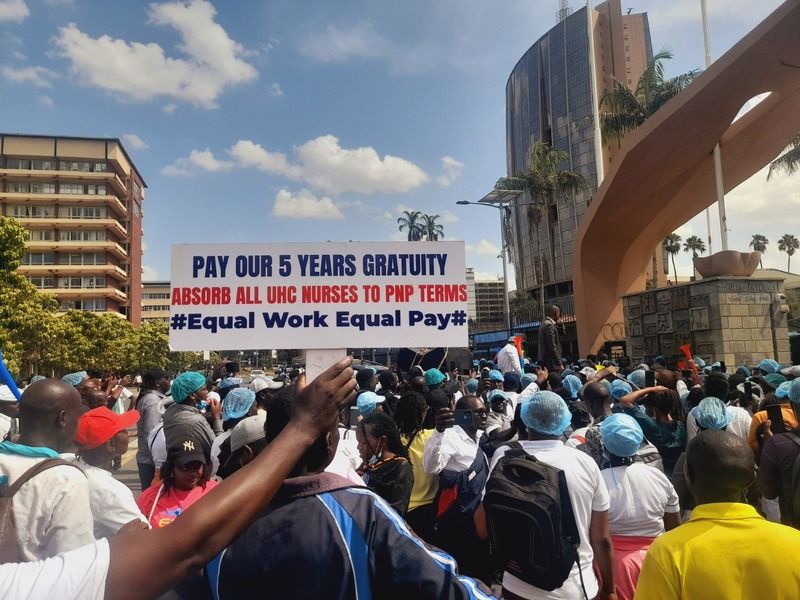
Shifting thousands of healthcare workers to county control without guaranteed funding or adequate planning threatens to destabilize service delivery. Many fear this could lead to even more industrial unrest at the county level, and patients may once again become collateral damage in a national tug-of-war over money and mandates.
At the heart of this entire debacle is the Kenyan citizen. Without a stable and adequately staffed healthcare system, the poorest and most vulnerable are left to bear the brunt. Clinics remain understaffed, doctors become overworked, and preventive care falls by the wayside.
The ripple effect goes beyond just treatment delays. Maternal health, child immunization, emergency response, and chronic disease management all suffer when systems operate under uncertainty. For a population still recovering from the economic and health shocks of the COVID-19 pandemic, this news could not come at a worse moment.
Aden Duale’s statement may have been brutally honest, but it was also a loud siren—warning that the country's health system is dangerously close to exhaustion. Budgetary constraints, while real, cannot excuse the chronic neglect of frontline workers who bear the weight of national health goals.
Unless urgent steps are taken—through strategic resource reallocation, genuine political commitment, and stronger county support—Kenya’s health dream could unravel. The question now is not just whether the government has money to pay doctors, but whether it has the will to fix a system too important to fail.






0 comments